What Does a Fractional COO Actually Do for a Small Business?
A fractional COO runs the operational side of your business part-time — building the systems, decision rights, and team accountability that keep things moving without everything routing back through you. They own the how of your company: processes, roles, execution, the day-to-day machine. You get senior operations leadership without the salary, equity, or full-time commitment of hiring a COO in-house. Think of it as the operator brain your business needs, at the fraction you actually need it.
So what does a fractional COO actually do all day?
They build the machine that runs your business — and then they make sure it actually runs. That’s the whole job, stripped down. Most of the day-to-day breaks into a few buckets.
Systems and processes: getting the “how we do things here” out of your head and into documented, repeatable workflows the team can follow without pinging you first. Decision rights and role clarity: defining who owns what, who decides what, and what actually needs to come to you — so calls stop landing on your desk by default. Team accountability and execution: setting the cadence of meetings, metrics, and reviews that keeps projects moving and people on the hook for outcomes. Tech and tool alignment: making sure the software you’re paying for is actually being used, and that you don’t have three tools doing one job badly.
Underneath all of it is one thing: a fractional COO owns the gap between what you decided and what actually happens. That gap is where most growing businesses quietly bleed time, money, and margin — and nobody’s job was ever to close it.
How is a fractional COO different from a full-time COO?
Same role. Different dosage.
A full-time COO is a senior hire — salary, benefits, equity, the whole package — usually running a bigger, more complex org day in and day out. A fractional COO does the same core work (systems, structure, execution) on a part-time, flexible basis. You bring them in for the leverage, not the headcount.
For a lot of small and growing businesses, a full-time COO is a $200K+ commitment for a role you might only need two or three days a week. The fractional model exists precisely because that math rarely works before a certain size. You get the operator experience without over-hiring for where you are right now. And a good fractional COO is designing toward being needed less, not more — the goal is a business that runs on structure, not on any one person, including them.
When does a small business actually need one?
Usually it’s not a revenue number. It’s a feeling.
You don’t have a motivation problem. You have an org chart with your name on every line.
The signs are pretty consistent. Revenue is fine — maybe even great — but every decision still routes back to you. You’ve hired good people, and they still wait on you before they move. You spend your days reacting instead of building. You can’t take a real week off without the wheels wobbling. Growth has started to feel heavier instead of lighter.
If two or three of those are landing, that’s not a you-problem. That’s a structure built for a smaller version of the company that never got redesigned as you grew. It’s incredibly common in the $2M–$20M range: the business outgrew its original operating layer, and rebuilding it was never actually anyone’s job. That’s the exact moment a fractional COO earns their keep.
What a fractional COO is NOT
Worth clearing up, because the title gets muddy.
A fractional COO is not a consultant who hands you a slide deck and disappears — they’re in the business, owning outcomes, not observing from the sidelines. They’re not a fractional CFO either; finance, forecasting, and reporting are a different lane, though the two often work side by side. They’re also not actively driving revenue – that’s the CEO, sales & marketing teams’ responsibility – though they will support the systems & processes behind sales & marketing. And they’re not a project manager or a virtual assistant. Those roles execute inside a system. A COO builds the system. Simplest test: if the work is about how the whole business operates and who’s accountable for what, that’s COO territory.
How BonBon Strategic thinks about it
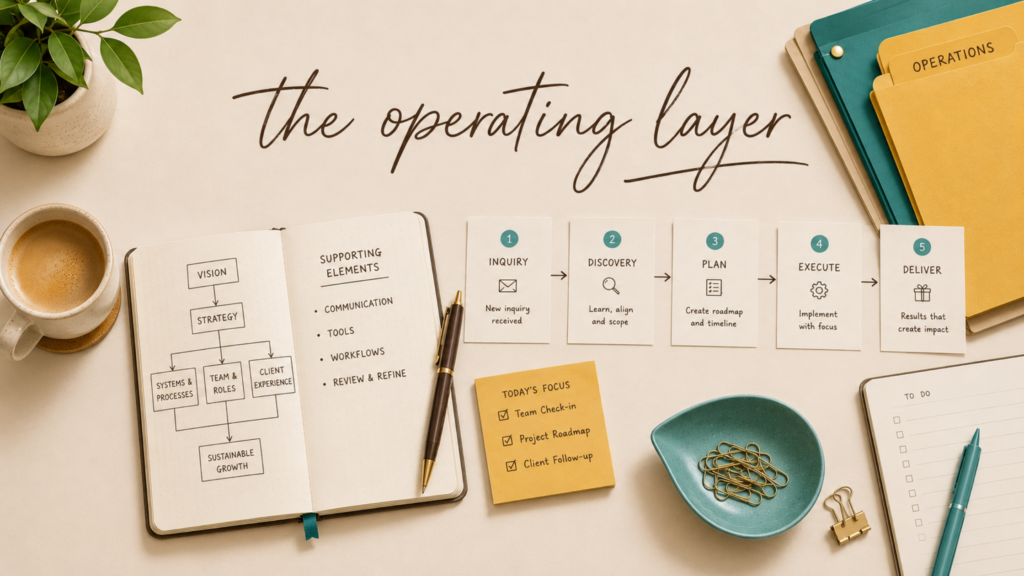
At BonBon Strategic, fractional COO work usually starts by rebuilding the operating layer — the strategy, systems, team structure, and support that let a business grow without running everything through the founder. We work with founders in New Orleans, Baton Rouge, and Lafayette, and remotely with clients across the US and Canada.
The point isn’t to add another person you have to manage. It’s to build the structure that means fewer things need managing at all. Fewer fires. Fewer bottlenecks. More of your calendar back.
Frequently Asked Questions
What does a fractional COO do for a small business?
A fractional COO builds and runs the operational side of a business part-time — systems, processes, role clarity, and team accountability. They take the “how work gets done” out of the founder’s head and turn it into structure the team can run on its own. The result is a business that moves without every decision routing back through the owner.
How is a fractional COO different from a full-time COO?
The role is the same; the commitment is smaller. A full-time COO is a salaried senior hire running operations daily, while a fractional COO does the same core work part-time and flexibly — often two to three days a week. It’s the right fit when you need operator-level leadership but don’t yet need, or can’t justify, a full-time executive salary.
When does a small business need a fractional COO?
Usually when the business is doing well but every decision still funnels back to the owner. Common signs include reacting all day instead of building, a capable team that still waits on you, and not being able to step away without things stalling. That’s typically a structural gap, not a leadership one — and it’s exactly what a fractional COO is built to fix.
Ready to figure out what’s actually getting stuck?
If any of this hit a little too close to home, that’s worth a conversation — not a sales pitch, just a straight look at where your business is getting stuck and whether the fix is structural.
Book a 20-minute intro call with Kate at BonBon Strategic. We’ll talk through what’s landing on your desk that shouldn’t be.
Not ready to talk to a human yet? Take the “Why Everything Still Runs Through You” quiz — a few minutes, and it shows you where the work actually bottlenecks and why so much still routes back to you.