
Fractional COO vs. Fractional CFO vs. Business Consultant: What’s the Difference?
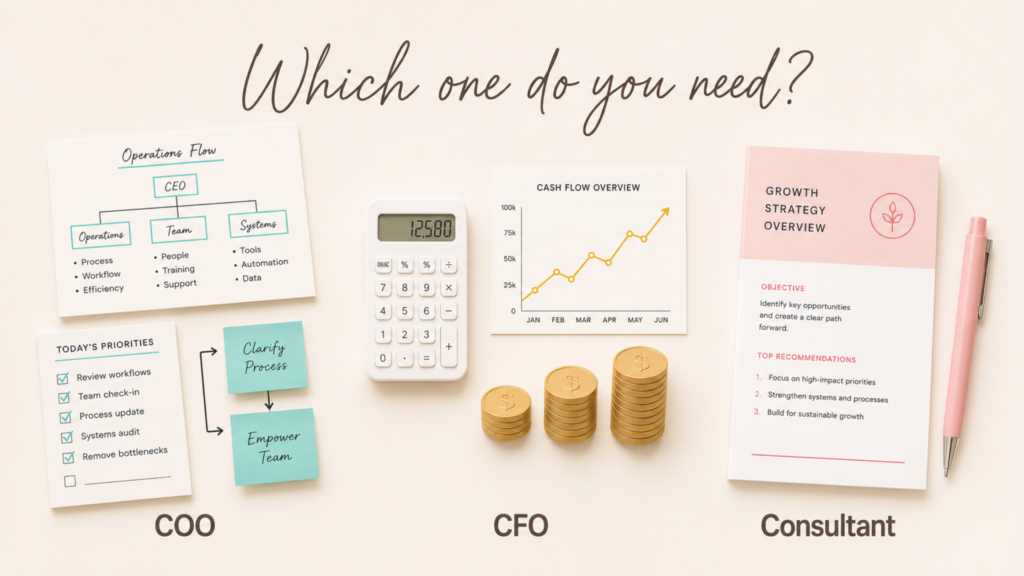
A fractional COO owns HOW your business runs — systems, operations, execution, and team accountability. A fractional CFO owns the MONEY — cash flow, forecasting, margin, and financial strategy. A business consultant advises and hands you a plan, but doesn’t stay to run it. The first two are embedded operators accountable for outcomes. The third is an outside advisor. Different jobs, not competing versions of the same one.
So what does each one actually own?
A fractional COO owns the operating layer — how work gets done, who’s accountable, and whether the machine runs without you sitting in the middle of every decision. Think systems, processes, team structure, execution, and the day-to-day. When your problem is that everything routes through you, this is the lane.
A fractional CFO owns the financial layer — cash flow, margin, forecasting, budgeting, pricing strategy, and the numbers that tell you whether the business is actually healthy under the hood. This isn’t bookkeeping (that’s your bookkeeper or controller). It’s the strategy sitting on top of the numbers — the “are we making money on the right things, and can we afford the next move” work.
A business consultant owns a recommendation. They come in, diagnose, and hand you a plan. Plenty of them are excellent at it. But the defining trait is that they advise from the outside and then leave you to execute.
A consultant hands you the map. An operator gets in the car.
Which one do I need?
Start with what’s actually breaking.
If the pain is operational — everything routes back through you, the team waits on you before they move, projects stall, nothing’s documented, growth feels heavier instead of lighter — that’s COO territory. If the pain is financial — you’re profitable on paper but cash is always tight, you can’t see which jobs or services actually make money, you’re guessing at forecasting — that’s CFO territory. And if you mostly need a fresh outside read on one specific decision you’ll run yourself, a consultant is the lighter-touch call.
Here’s the fastest gut check: is the problem knowing what to do, or getting it done? A consultant solves the first. A fractional COO solves the second.
Most founders in the $2M–$20M range who feel buried don’t actually have an information problem. They know what needs to happen. What’s missing is the structure and the person accountable for making it happen — which is exactly why the fractional COO conversation comes up so often at that stage.
Can I have more than one at once?
Yes — and often you should.
A COO and a CFO aren’t competitors. They’re two halves of the same leadership bench. The COO builds the operating system; the CFO makes sure the money side supports it. They work side by side constantly. The only real risk is coordination — you don’t want three specialists each optimizing their own lane while you play air-traffic controller in the middle.
That’s the trap a lot of founders back into without realizing it. You hire a marketing person, then a CFO, then an ops consultant, then a systems VA — and somewhere in there you become the connective tissue holding all of them together. That’s more work, not less. It’s not a hiring mistake on your part; it’s what happens when specialists get added one at a time with no one owning how they fit together.
Where do the lines blur — and where don’t they?
In the real world, titles overlap. A sharp fractional COO thinks about margin. A sharp CFO cares how operations drive the numbers. Good ones don’t stay rigidly in their box.
But the ownership line holds. The COO is accountable for how the business runs. The CFO is accountable for whether the money works. A consultant is accountable for the quality of the advice — not the outcome. When you’re deciding who to bring in, that accountability line matters more than the title on the invoice.
How BonBon Strategic fits
At BonBon Strategic, the work usually starts on the COO side — rebuilding the operating layer so the business runs on structure instead of on you. When the money side or another specialty needs to come in, we bring in coordinated specialists through the BonBon Collective rather than leaving you to stitch together a patchwork of independent hires. We work with founders in New Orleans, Baton Rouge, and Lafayette, and remotely with clients across the US and Canada.
The point isn’t more people for you to manage. It’s one coordinated team, with the operating strategy holding it together — so you stop being the glue.
Frequently Asked Questions
What’s the difference between a fractional COO, a fractional CFO, and a consultant?
A fractional COO owns how the business runs — operations, systems, team, and execution. A fractional CFO owns the financial side — cash flow, forecasting, margin, and financial strategy. A business consultant advises from the outside and hands you a plan but doesn’t stay to run it. The first two are embedded operators accountable for outcomes; the third is an advisor.
Which one do I need?
Match the role to the pain. If everything routes through you and execution is the bottleneck, that’s a fractional COO. If you’re profitable but cash-strapped or flying blind on the numbers, that’s a fractional CFO. If you need a one-time outside read on a decision you’ll execute yourself, a consultant may be enough. The gut check: is the problem knowing what to do, or getting it done?
Can I have more than one at once?
Yes, and it’s common. A fractional COO and CFO cover different lanes — operations versus finance — and often work side by side. The key is coordination, so specialists don’t operate in isolation and leave you as the connective tissue between them. At BonBon Strategic, that’s exactly what the Collective is built to prevent: specialists deployed under one strategic oversight instead of a patchwork you have to manage yourself.
Not sure which lane your problem lives in?
That’s a normal place to be — the symptoms overlap, and “buried” doesn’t come with a label telling you whether it’s an operations or a money problem.
Book a 20-minute intro call with Kate at BonBon Strategic. We’ll figure out where the real bottleneck actually sits before you hire anyone for anything.
Want a faster first step? Take the “Why Everything Still Runs Through You” quiz — a few minutes, and it points you to where the work is actually piling up before you talk to anyone.