Signs You’re Too Overwhelmed to Run Your Own Operations
The clearest signs: every decision routes back to you, you spend your days reacting instead of building, your team waits on you before they move, and you can’t take a week off without things stalling. If revenue is fine but the business only runs when you’re in the middle of it, you’re not just busy — you’ve hit a structural ceiling, not a personal one. Overwhelm at this level is a symptom, not a character flaw.
So what are the actual signs?
Operational overwhelm rarely announces itself. It doesn’t look like failure — it usually looks like a successful business that quietly can’t function without you. Here’s what it actually looks like on the ground.
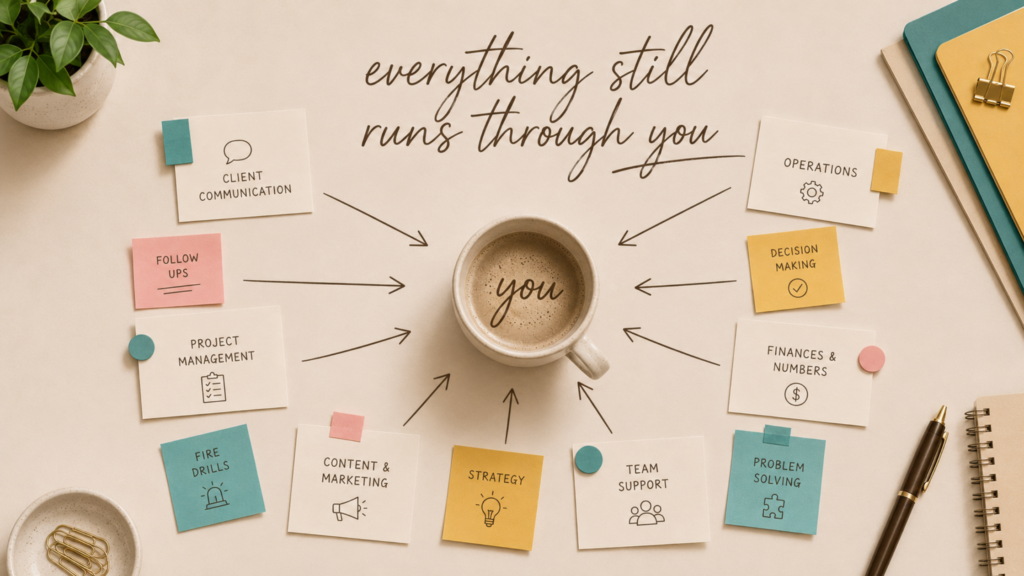
Every decision funnels to you. You’re the default escalation point for things that shouldn’t need you — pricing questions, scheduling conflicts, “hey, quick question” interruptions that add up to your whole day. Not because your team is incapable, but because there’s no defined owner for those calls except you.
You’re reacting all day, never building. You start the morning with a plan and end it having done none of it, because the day got eaten by whatever caught fire. Strategic work keeps sliding to “when things calm down.” Things never calm down.
Your team waits on you before they move. You’ve hired good people, and they’re still parked at your door for a green light. That’s not a hiring miss — it’s a sign the authority and process to move without you were never built.
You can’t step away. A real vacation feels impossible, and the one time you tried, the wheels wobbled the second you were unreachable. A business that stalls when the founder logs off is a business running on a person, not a structure.
Nothing’s written down. Every situation is a one-off that requires your judgment because the “how we do this” lives in your head, not in a documented process. So it all comes back to you, again.
If two or three of those are landing, that’s the signal. And notice what they all have in common: none of them are about how hard you’re working.
Is overwhelm a time problem or a systems problem?
Almost always a systems problem wearing a time problem’s clothes.
This is the trap. When you feel buried, the instinct is to reach for time-management fixes — a better calendar, earlier mornings, a tighter to-do list, one more productivity app. They work for about a week. Then the overwhelm comes right back, because the root cause was never your time. It was that work and decisions had nowhere to live except with you.
The problem isn’t how much you’re doing. It’s that the business can’t do any of it without you.
Until the structure changes — until work has a clear owner and a path that isn’t you — no amount of personal discipline closes the gap. We went deep on this idea in our companion piece, “Wearing Too Many Hats Isn’t a Time Problem. It’s a Design Problem.” This post is the mirror image: that one explains the why, this one helps you spot the signs.
Why does more hustle make it worse?
Because hustle reinforces the exact structure that’s burning you out.
Every time you personally jump in to solve something, you confirm — to your team and to the business — that you’re the one who solves it. The escalation path to you gets more worn, not less. You become more central, more indispensable, more of a bottleneck. Working harder inside a broken structure doesn’t relieve the pressure; it deepens the groove. That’s why the most capable, hardest-working founders often feel the most trapped. Their effort is holding up a structure that should be holding up itself.
What can I do about it?
Start by separating the symptom from the cause. Map where decisions actually escalate to you and what genuinely only you know how to do. That list is your bottleneck, made visible.
Then rebuild the structure so work has a clear owner and a documented path that isn’t you — defining decision rights, documenting the core processes, and putting the operational leadership in place to run it. Sometimes that’s a system. Sometimes it’s a person, like a fractional COO, whose whole job is owning the operating layer so you can step out of the middle. The goal isn’t to work less hard. It’s to build a business that runs on structure instead of on you.
How BonBon Strategic thinks about it
At BonBon Strategic, this is the whole job — rebuilding the operating layer so the business stops running through the founder. We start by finding where things actually bottleneck, then put the structure and ownership in place so decisions, execution, and accountability don’t all route back to one person. We work with founders in New Orleans, Baton Rouge, and Lafayette, and remotely with clients across the US and Canada.
The outcome founders actually want isn’t a lighter to-do list. It’s a business they can step away from without it wobbling — fewer fires, protected margin, and their calendar back.
Frequently Asked Questions
How do I know if I’m too overwhelmed to run my operations?
The clearest signal isn’t how many hours you’re working — it’s whether the business can function without you in the middle of it. If every decision escalates to you, your team waits on you before acting, and you can’t step away without things stalling, that’s operational overwhelm. It usually shows up not as failure but as a successful business that quietly depends on you for everything.
Is overwhelm a time problem or a systems problem?
Almost always a systems problem wearing a time problem’s clothes. Time-management fixes — better calendars, earlier mornings, tighter to-do lists — help for a week and then the overwhelm returns, because the root cause is structural: work and decisions have nowhere to live except with you. Until the operating structure changes, no amount of personal productivity closes the gap. We cover this in depth in our companion piece, “Wearing Too Many Hats Isn’t a Time Problem. It’s a Design Problem.”
What can I do about it?
Start by separating the symptom from the cause — map where decisions actually escalate and what only you know how to do. Then rebuild the structure so work has a clear owner and a documented path that isn’t you, whether that’s defining decision rights, documenting core processes, or bringing in operational leadership like a fractional COO. The goal isn’t to work less hard; it’s to build a business that runs on structure instead of on you.
If this sounds like your Tuesday…
None of these signs mean you built the business wrong. They mean it outgrew the structure it started with — and that’s fixable.
Book a 20-minute intro call with Kate at BonBon Strategic. We’ll pinpoint where things are actually bottlenecking and what it’d take to get your calendar back.
Not ready to talk yet? Take the “Why Everything Still Runs Through You” quiz — a few minutes, and it names exactly where the overwhelm is coming from.